Thursday, October 29, 2009

360 panorama of 4,000 islands

Blog by Paul Stewart --- full 360 degree panoramas of Mekong scenes. Check out 4,000 islands, directly upriver and left a few hundred meters is right where the dam will be.

http://mouthtosource.net/rivers/mekong/


My photo, dam site in Hou Sahong:

the priorities (development and livelihood) must be balanced --- alan brooks

Today I met with Alan Brooks, director of the greater Mekong regional office of the World Fish Center (headquarters in Malaysia).

In response to me asking if the locals in the Khone Falls care about this dam or not, he said, "Many will see the immediate gains first. The problems will be awareness. There are lots of implications of the longterm facts for fishermen, and the priorities must be balanced."

"There is an estimated 9 million fish that pass through the Khone Falls region per hour."

Brooks would like to link up the World Fish Center with other agencies so that they can all consolidate their information and their power and create a kind of social net, like similar issues have in the West. "If dams are not the solution to the need for power and investment, then what is? What solutions can satisfy these long term needs?"

"The Don Sahong dam will definitely have an impact on fish production, livelihoods, and fisheries. However, the development priorities for benefits derived from hydropower must be considered."

"It's about urbanization and those centers with the biggest demand for power. Green technologies cannot provide sufficient power for cities."

The Cambodian government asked the World Fish Center to do an environmental impact assessment of the dam, and they "declined because we think a Cambodian government institution should lead. We will provide them with technical support. But we are a research organization and it is not our role to do these (EIAs)."

The talk with Brooks was good because it gave me a broader scope on the issue. He was the first person I have talked to to say that the demand for dams for investment and development is there and real, and it needs to be satisfied with something. It just needs to be considered right along with food security and livelihood.

-- We grow these rice fields on top of the backs of our fish --

Yesterday I had lunch with Ian Baird, the expert on Khone Falls, the guy who really knows everything there is to know about this location, and the guy who has written so many of these reports that I am using to base my article.

He is from Canada but has been living in Laos for the better part of the last 15 years. He left the Khone Falls area when it got too touristy and moved to Pakse (the biggest town in the area) to continue his research of the fish and ecology of the region.

His latest report that I use can be found here: http://www.polisproject.org/PDFs/Baird%202009_Don%20Sahong.pdf

We talked for a long time about the one thing in the research that cannot be found: the total number of fish that pass through Hou Sahong and migrate in general... not just the number of fish caught, but the number of fish that are not caught. It doesn't only matter what's caught at the falls itself, but the numbers caught all along the Mekong. The fish that pass through the falls area migrate all the way up to Vientiane (Laos)," Baird explained to me.

This number would tell us not just the amount of fish caught at the Khone Falls area but how many could be possibly caught all up and down the Mekong. After all, that is the issue at hand - fisheries 1000 km north and south of the Khone Falls rely on fish that migrate through the Khone Falls area.

This number will also tell us the actual whole monetary value of the fisheries in the Mekong that rely on the migrating fish (most of them), which will inherently tell us the monetary loss that will be experienced if the dam is built. Some countries have tried to record things like this with lasers and cameras. It's very expensive to keep a laser or a camera on something like the Hou Sahong, a 100 meter-wide channel.

Baird also explained to me that he didn't think I had the right interview and the right impression that reflects most the people of the the area in terms of damming Hou Sahong. The policeman I talked to is a border cop and therefore very much in a position to need to say things pro-government. (The policeman said he wanted a dam and that fishermen could easily use other channels). "The people there understand the importance of the Hou Sahong channel and do not want to dam it and lose their fishing income. They are water people. That's what they know, is fish. They actually own parts of the river as if it was land. You can't just move these people inland and expect them to eat lizards and things, their lives are on the river. It's like making a fish into a pigeon," Baird said.

"We grow these rice fields on top of the backs of our fish," is a Lao saying that shows how dependent the people of the Mekong really are on their fish.

Baird said that people are still very afraid of the government since the early 80s when the communist Pathet Lao party took over the monarchy and aligned Lao with Vietnam. He said people were imprisoned in the 80s....and trailed off, but now there is no violence, there is only the memory of it. And so if people see you with a notebook or a camera, they will no say anything anti-government.

Anyway, it was good to clear up on what exactly needs to be known - total # fish - and meet the person behind all of these studies.

Tuesday, October 27, 2009

Cambodia - decentralized energy from the start


This movie doesn't have anything to do with the decentralized energy stuff from yesterday at the conference. I took this when I was actually at the Hou Sahong channel and I just finally uploaded it. This is just one narrow channel of many in this area, where the Mekong stretches to 14 km wide. Shows ya how strong and how much water flows through here.

So the energy workshop proved to be very interesting and brought to my attention a different angle on the issue at hand, electrification of rural Cambodia and how to do it right from the start.

Cambodia and Laos are in very unique positions right now because they cut up their land for energy yet. I mean, they haven't dammed up the most important parts of the Mekong, they haven't cut their entire forests (although they are logging rampantly), they haven't put transmission lines all over their land. What if they were able to skip the damaging steps that a central electricity program takes (entities owned by public or private firms) and start with a sustainable and local form of electricity?

Rural electrification is very expensive (and 40% of the cost is transmission) unless it could be done in a de-central way, that is through things like solar panels, biomass into combustible gas (rice husks, wood chips, cashew and peanut shells), and methane pig farms.

I met Carl Middleton, Mekong rep for International Rivers. He told me that fisherman up in the Khone Falls area just accidentally caught a giant catfish, 200 kg, in one of their traps! It's endangered and they only catch these things like every two years. It is illegal to catch them, and Carl said the government came in immediately and took the fish carcass away. I am trying to find more on this, and I think Ian Baird will be able to tell me more today.

Also present at the meeting was Kamworks, a solar panel light companies with "moonlights," small, durable, inexpensive lanterns that run on solar energy and cost about

There is a micro hydro power dam in Chang Mai, Thailand, that produces 40 kw and profits $13,00 yearly selling energy back to Thailand. A village in Poi Et burns rice husks and uses the combustible gas to make electricity, and sells its energy back to Thailand.

Pig farms in Thailand put manure in a digester and use the methane, which also keeps clean their water supply and village. The laws that Thailand has to make this possible just aren't in place yet in Cambodia or Laos, and that is what these NGOs are trying to get moving.


Bangkok Airport powers itself completely because it cannot rely on the Bangkok
s grid system. It runs off a 45 mw gas fire cogeneration plant, and it uses all of the water heated up to produce air conditioning for the entire place.

Mr. Witoon Permpongsacharoen from Mekong Energy and Ecology Network spoke about decentralizing energy in Cambodia and also about how to forecast energy demands. He said Thailand over forecasts their demands, and this disrupts production efforts in Cambodia and Laos, where they try to produce and sell to Thailand and in turn ruin some of their own resources (ie Hou Sahong channel).
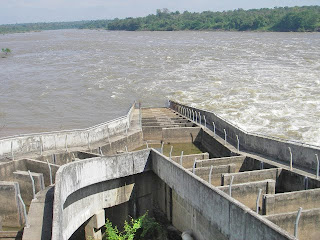
He also spoke of the Pak Mun Dam (136 MW) on the Mun River in Thailand, a shining example of the damage a major hydroelectric dam can do to a region. Built in 94 by the Electricity Generating Authority of Thailand with US$24 million in financing from the World Bank, the dam has blocked fish migration and hurt the livelihoods of 20,000 people. The fish ladder, promoted by the World Bank’s fisheries experts as a mitigation measure, has proved useless because the species in the Mekong don't respond to it like jumping salmon do, in the US, for example.

(picture from International Rivers)


Carl Middleton, in his presentation, asked the audience, in reference to dams, "Why are we still using technology that is over 100 years old? It doesn't make sense and it undermines other forms of development. We can generate electricity close to where the need is and save money. In Cambodia, we still have the choice to choose decentralized energy. Of course all sources of power should be subject to community approval."

Monday, October 26, 2009

Happy Phnom Penh


This is walking downtown by the Tonle Sap River. People are synchronized dancin on the right, a big rain storm is on its way, and Carrie just got suckered into give an Australian money cause he lost his life on a train, and we need dinner!


I like Phnom Penh, there is a central downtown and a median on the biggest road with fountains and grass and it's lit up with disco lights and glow in the dark toys at night. It's more expensive here and harder to find good cheap food, but I can't say I mind the gourmet (baguette) sandwiches or espresso drinks for a change.

The people here have been the friendliest yet for me, except for in the most rural parts of Laos. People here are goofy, a lot of people speak English and many do heckle you to get in their tuk tuk and go on a tour, but they respond to silly faces or jokes too. I walk out of my second floor room onto a balcony and immediately the tuk tuk driver on the street says, ""Lucy! Lucy! hello! Where you go!" and I will holler back at him, "Can you take me downstairs? I need some coffee!" and he will just burst out laughing.

Phnom Penh is on the Tonle Sap River, which is the only river in the world to run backwards with the changing seasons. Next week the dry season officially starts here, and the Tonle Sap will start draining from the Great Lake into the Mekong River. When wet seasons happens, the Tonle Sap switches and drains into the Great Lake (which is what makes it such a good place for fish to grow). The population of Phnom Penh doubles for festivals and parties by the river.

I've been working in Phnom Penh for the last 3 days or so, trying to organize my facts and my thoughts and put them down on paper. The hardest part about this, after tracking people down, is writing down everything I know now in a easy and interesting to read, flowing form.

Tomorrow I am going to "Powering the 21st Century Cambodia: Rethinking Cambodia's Energy Future Workshop," hosted by the Cambodia NGO forum. It'll be about how to change the policies in Cambodia to help Cambodia meet its energy need more sustainably. It's not about any of the dams because they are trying to stop talking about dams and move onto other types of energy.

I have a meeting with Ian Baird, Mekong fish expert from the University of Victoria in Canada, on Wednesday. And I am trying to meet with someone from the World Fish Center this week before I leave on Friday.

I am with Carrie's TEFL training group and staying with them in their villa. I will go with them to Angor Wat on Friday, but I will be sure to update on the latest from the meetings this week.

Thursday, October 22, 2009

Notes from Cambodia NGO forum

I met with the an adviser from the NGO forum for Cambodia's environment program, she asked that I not use her name.

She gave me some interesting information:

- a French company is paying for a feasibility study on a different channel in the Khone Falls area close to Don Sahong (DSD). It would be 40 mw and it is EIA (environmental impact assessment approved). DSD is EIA approved also.... and DSD is most advance because it has a project agreement set up between the Lao government and Mega First.

- The EIA that the Cambodian National Mekong Committee, CNMC, did for DSD has not been released to the public and it's been completed for years.

- Two dams on the Mekong in Cambodia (Stung Treng and Sambor Dams) have not started building but will relocate 30,000 people if they 'pass' the EIA.

- The value of fish in the Mekong River is $3.2 billion per year.

- There is no way to mitigate water levels and the effects on fish in the Mekong because the fish are so diverse, the water levels are so extreme, and the fish migrate 1000s of kilmoeters yearly. There is no technology to mitigate fish migration. However, the Mekong River Commission says that there are ways to mitigate this and there are ways to be sustainable, such as making the Hou Sadam channel wider manually, but this would not be cost effective and it just wouldn't work.

- Yali Falls Dam in Vietnam (on a tributary of the Mekong) lost 76% of its fish after it built the dam.

- Yali Falls caused many ill effects in Vietnam... drownings, toxic blue green algae from too much oxygen in water, less river farming because of the higher water levels. Tributaries of the Mekong are up to each individual country...mainstream Mekong is up to the MRC.

-Cambodia's position on the DSD is to wait and see if the fish die in Laos. If they do, then Cambodia will build, because saving the fish won't be an issue anymore.

- It's a build - operate - transfer system, which means a private company builds a dam, operates a dam, and 40 years down the road gives it to the respective government. Dams last about 50 years.

Tuesday, October 20, 2009

Quick facts for Don Sahong

Don Sahong is not actually a dam, but a "run-of-river" project, like a water turbine.

Will be built by Mega First Corporation Berhad, a Malaysian company.

USD 300 million project
240 megawatts of electricity